
Low voltage billing readiness
Low Voltage Billing Readiness Software
Low voltage contractors do not only need to finish the work. They need to prove the work is complete, close out the exceptions, collect the right documentation, and give accounting enough confidence to invoice. Billing readiness is the operating layer between field completion and cash collection.
Why billing readiness matters for low voltage contractors
For commercial low voltage teams, billing delays rarely come from one obvious failure. They usually come from missing pieces that nobody notices until the project is already winding down: a change order that was discussed but never approved, an EOD update that never came in, photos sitting on a technician's phone, test results in a separate folder, a customer sign-off still waiting, or a punch item that nobody tied back to invoice status.
The field may consider the job done. The PM may consider the job mostly wrapped. Accounting may still see risk. Ownership may see revenue that should be collected but is not moving. That gap is what billing readiness is meant to close.
A strong billing readiness process gives the company a simple answer to a high-value question: which jobs can be invoiced today, which jobs are blocked, who owns the next action, and what proof is missing?
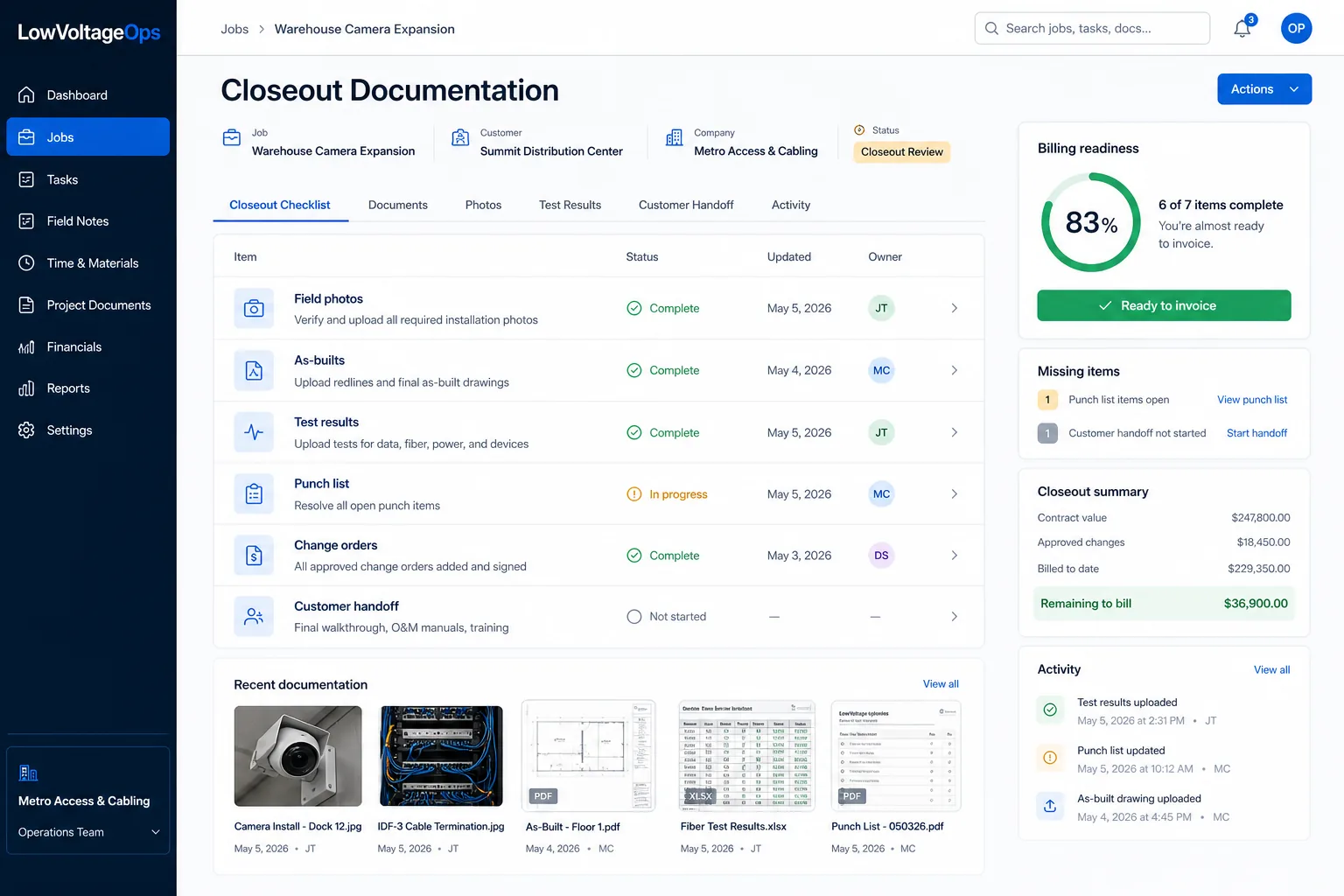
A practical billing readiness workflow
The best billing process starts before the final invoice. Low voltage contractors should treat billing readiness as a live job status, not a last-minute accounting task.
- Scope is connected to the job. The approved proposal, exclusions, alternates, billing terms, and customer expectations are visible from the job record.
- Field work creates proof as it happens. Technicians capture notes, photos, blockers, installed work, return-trip reasons, and customer requests while the details are fresh.
- Change work is flagged early. Out-of-scope work is logged with context, approval status, price impact, and invoice status.
- Closeout requirements are tracked by job type. Cabling jobs may need test results and as-builts. Security jobs may need camera views, device lists, training notes, and customer handoff. Access control jobs may need door schedules and credential handoff.
- PMs review exceptions weekly. The PM can see what is missing, blocked, pending approval, or ready for accounting review.
- Accounting receives a clean handoff. Invoice amount, approved changes, backup documents, retainage notes, and open exceptions are visible without a long chase.
- Owners see ready-to-bill revenue. Leadership can separate completed field work from invoice-ready work and identify where cash flow is stuck.
Billing readiness checklist for low voltage projects
This checklist gives PMs, operations leaders, and accounting a shared standard for deciding whether a job is ready to invoice.
| Readiness item | What to confirm | Why it matters |
|---|---|---|
| Approved scope | Contract, proposal, exclusions, alternates, and billing terms are attached. | Prevents invoice confusion and scope disputes. |
| Field proof | Notes and photos show completed work, site conditions, blockers, and customer requests. | Gives PMs and accounting evidence without chasing the field. |
| Change orders | All changes are approved, rejected, pending, or intentionally written off. | Protects margin and reduces unbilled work. |
| Closeout documents | Required test results, as-builts, device lists, training notes, and handoff files are present. | Stops closeout from delaying invoice review. |
| Punch list | Open items are complete, assigned, blocked, or excluded from the current invoice. | Clarifies whether punch work should hold billing. |
| Customer approval | Sign-off, written acceptance, milestone approval, or customer communication is recorded. | Reduces invoice disputes and follow-up delays. |
| Accounting handoff | Invoice amount, backup, terms, retainage, progress billing, and exceptions are ready. | Moves work from operationally complete to collectible. |
What each team needs to see
Billing readiness works when every role can see the same job truth through the lens they need.
- Owners need ready-to-bill revenue, blocked revenue, billing lag, margin risk, and jobs waiting on closeout.
- Project managers need missing field notes, pending changes, punch ownership, customer approvals, and closeout status.
- Field leads need a simple way to submit notes, photos, completion updates, blockers, and required closeout items.
- Accounting needs invoice backup, approved billing terms, change order status, retainage notes, and exceptions.
- Service teams need final installed details and documentation so future work does not start from scratch.
Billing readiness metrics owners should track
Once billing readiness is visible, it becomes a management metric instead of a hidden administrative delay. Owners should review these numbers weekly:
- Ready-to-bill revenue: work that can be invoiced now.
- Blocked billing revenue: completed or near-complete work waiting on proof, approval, closeout, punch, or accounting review.
- Average billing lag: days between field completion and invoice sent.
- Missing closeout count: jobs waiting on test results, photos, as-builts, training, or sign-off.
- Pending change order value: revenue at risk because change work has not been approved or billed.
- Jobs stale after field completion: jobs where crews have rolled off but the job is still operationally open.
These metrics help leadership see whether the company has a sales problem, a production problem, a documentation problem, or a billing handoff problem.
How LowVoltageOps supports billing readiness
LowVoltageOps connects job management, field updates, scheduling, documents, closeout, profitability reporting, and billing readiness in one operating workflow for commercial low voltage contractors.
The goal is to reduce the manual chase between field teams, PMs, operations, accounting, and ownership. Instead of rebuilding the job story at the end, the system keeps the job record current as work happens.
Frequently asked questions
What does ready to bill mean for a low voltage contractor?
Ready to bill means the company has enough approved scope, field proof, closeout documentation, change order status, punch list clarity, and accounting information to send an invoice without unnecessary follow-up.
How is billing readiness different from closeout?
Closeout is the documentation and handoff process that proves the job is complete. Billing readiness includes closeout, but also includes invoice amount, billing terms, approved changes, retainage, customer approval, and accounting backup.
Can billing readiness improve job profitability?
Yes. Billing readiness improves profitability by protecting change order revenue, reducing unbilled work, exposing margin risk earlier, shortening billing lag, and helping owners see where cash flow is stuck.