
Target query: Knowify alternative for low voltage
Knowify Alternative for Low Voltage Contractors
Contractors usually search for a Knowify alternative when the business has outgrown scattered job tracking, delayed billing backup, unclear field updates, or reporting that does not explain job health fast enough. For low voltage contractors, the key question is not just whether a tool can estimate or invoice. The question is whether it can run the full operating workflow from proposal to field work to closeout to billing readiness.
Why low voltage contractors search for a Knowify alternative
Knowify can be a useful tool for many contractors, especially when the company wants estimating, job costing, time tracking, and billing support in one place. The issue for low voltage teams is that the work often carries details that do not behave like a simple construction project or a simple service call. A structured cabling job needs cable counts, labels, test results, as-builts, room-by-room progress, and closeout documentation. A security job may need camera views, door schedules, credentials, device programming, customer training, monitoring information, and service history. An AV job may need equipment status, commissioning notes, rack details, and punch list follow-up.
When those details are not connected to the job record, the PM has to chase them through text messages, emails, photos, spreadsheets, and folders. That creates a familiar pattern: the field work gets done, but billing waits because the office cannot prove what was completed, what changed, what is approved, or what is still missing.
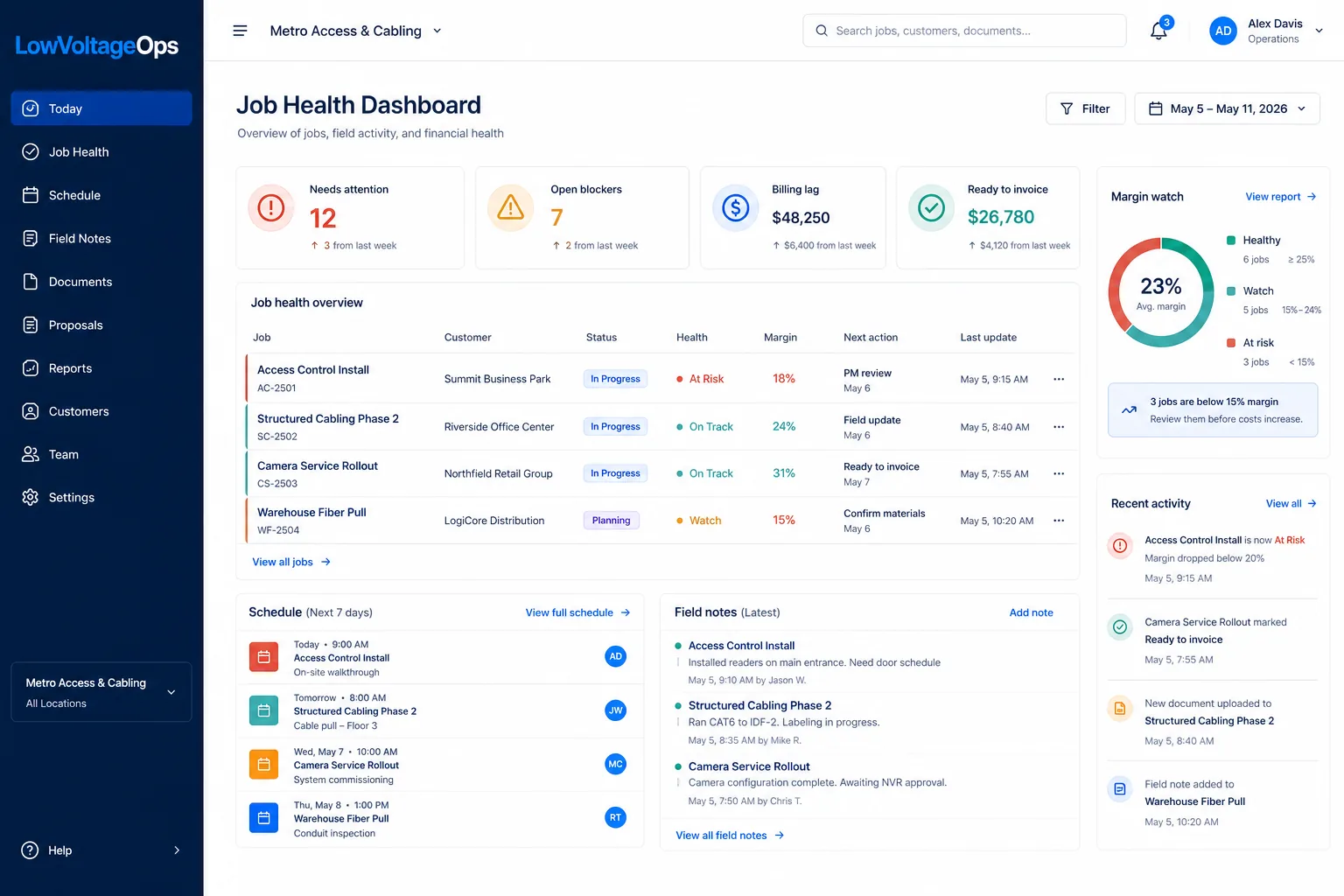
A strong Knowify alternative for low voltage contractors should reduce that chase. It should make job status, field notes, schedule risk, documents, change orders, and billing readiness visible without forcing the team to rebuild the truth every week.
How to compare Knowify alternatives for low voltage work
Before comparing software names, compare the operating problems. A tool that looks good in a feature checklist can still fail if it does not match how a low voltage contractor actually sells, schedules, installs, documents, bills, and reviews work.
| Evaluation area | What to ask | Why it matters for low voltage |
|---|---|---|
| Job tracking | Can PMs see job status, next action, blockers, and owner quickly? | Low voltage projects often stall because the next action is hidden in a message thread or someone's memory. |
| Field updates | Can techs add notes, photos, site issues, and completion updates from the field? | Field proof protects change orders, explains labor, and prevents end-of-job documentation scrambles. |
| Scheduling | Does the schedule connect to job readiness, field workload, and project milestones? | A calendar alone does not show whether the site is ready, material is available, or prior work is complete. |
| Closeout documentation | Can the system track required closeout items by job type? | Cabling, cameras, access control, AV, and fire/security workflows all need different proof before handoff. |
| Billing readiness | Can accounting see what is ready to invoice and what backup is missing? | Finished work does not help cash flow if billing waits on photos, tests, approvals, or change orders. |
| Profitability reporting | Can owners see labor burn, change orders, billing lag, and margin risk? | Low voltage margins are often lost through small undocumented changes and avoidable return trips. |
What makes a Knowify alternative fit low voltage contractors
The right fit should help the company operate around the full job record. That record should include proposal details, scope, contacts, schedule, field notes, photos, files, change items, closeout status, billing status, and reporting. If one of those areas lives outside the system, someone eventually has to reconcile it by hand.
Project and service work in one operating view
Low voltage contractors frequently manage projects and service at the same time. A company may install a new access control system, return for punch work, handle a service ticket on an existing camera system, and prepare a quote for another phase in the same week. Software should help the team see both project commitments and service activity without losing the customer, site, or job history.
Field documentation that supports billing
Field notes are only valuable if the office can use them. A note should connect to the job, location, system, person, date, and next action. Photos should have enough context to prove work, explain a blocker, or support a change request. If field documentation cannot support billing, closeout, or customer communication, it becomes noise.
Closeout that starts before the final day
Closeout should not be a panic folder at the end of the job. For structured cabling, the checklist might include test results, as-builts, rack photos, labels, and customer acceptance. For security, it might include device lists, camera screenshots, credential handoff, monitoring notes, and training. The software should show what is missing while there is still time to fix it.
Owner reporting that shows what needs attention
Owners do not need another static report. They need to know which jobs are behind, which jobs are ready to bill, which jobs have margin risk, and which PMs need help. That is why low voltage reporting software should connect to real job activity instead of being a separate spreadsheet exercise.
A better workflow for low voltage contractors evaluating Knowify alternatives
Use this workflow as a practical test. If a tool cannot support these steps cleanly, it may create extra work as the company grows.
- Proposal created: Scope, assumptions, exclusions, alternates, and expected labor are captured clearly.
- Job opened: Customer, site, scope, files, schedule needs, and PM ownership are visible in one record.
- Field scheduled: Crews see where to go, what to do, who to contact, and what proof to collect.
- Field updates submitted: Notes, photos, blockers, material issues, and change requests flow back to the job.
- PM reviews risk: The PM can see schedule changes, missing documentation, labor burn, and open customer decisions.
- Closeout package prepared: Test results, as-builts, photos, punch items, training, and approvals are tracked by job type.
- Billing readiness confirmed: Accounting knows what is ready to invoice and what still needs backup.
- Leadership reviews margin: Owners can see job health, profitability, billing lag, and operational bottlenecks.
This is the operating loop LowVoltageOps is built around. It is why the product is positioned as low voltage contractor software, not just a generic contractor app.
When Knowify may still be a good fit
A fair comparison should be honest. Knowify may be a reasonable fit for contractors that mainly need estimating, contract management, time tracking, accounting-connected workflows, and general job costing. If the team is already operating cleanly and the missing piece is mostly financial workflow structure, it may be worth evaluating.
LowVoltageOps becomes more relevant when the pain is operational: field notes are scattered, job status is unclear, schedules change without visibility, closeout documentation delays billing, change orders slip through, and owners cannot quickly see job health across active work.
Frequently asked questions
What is the best Knowify alternative for low voltage contractors?
The best Knowify alternative depends on the contractor's workflow. Low voltage contractors should compare tools around job tracking, field updates, scheduling, closeout documentation, billing readiness, and job profitability. LowVoltageOps is built specifically around those low-voltage operating needs.
Why do low voltage contractors need different software?
Low voltage work combines project management, service work, documentation, devices, drawings, field photos, test results, scheduling, change orders, and closeout packages. Generic contractor software may support pieces of that workflow, but low voltage contractors need those pieces connected.
Can LowVoltageOps replace spreadsheets?
LowVoltageOps is designed to replace scattered spreadsheets, text-message job updates, disconnected folders, and manual job health reports with one operating workflow for low voltage contractors.