
Target query: low voltage estimating and project management software
Low Voltage Estimating and Project Management Software
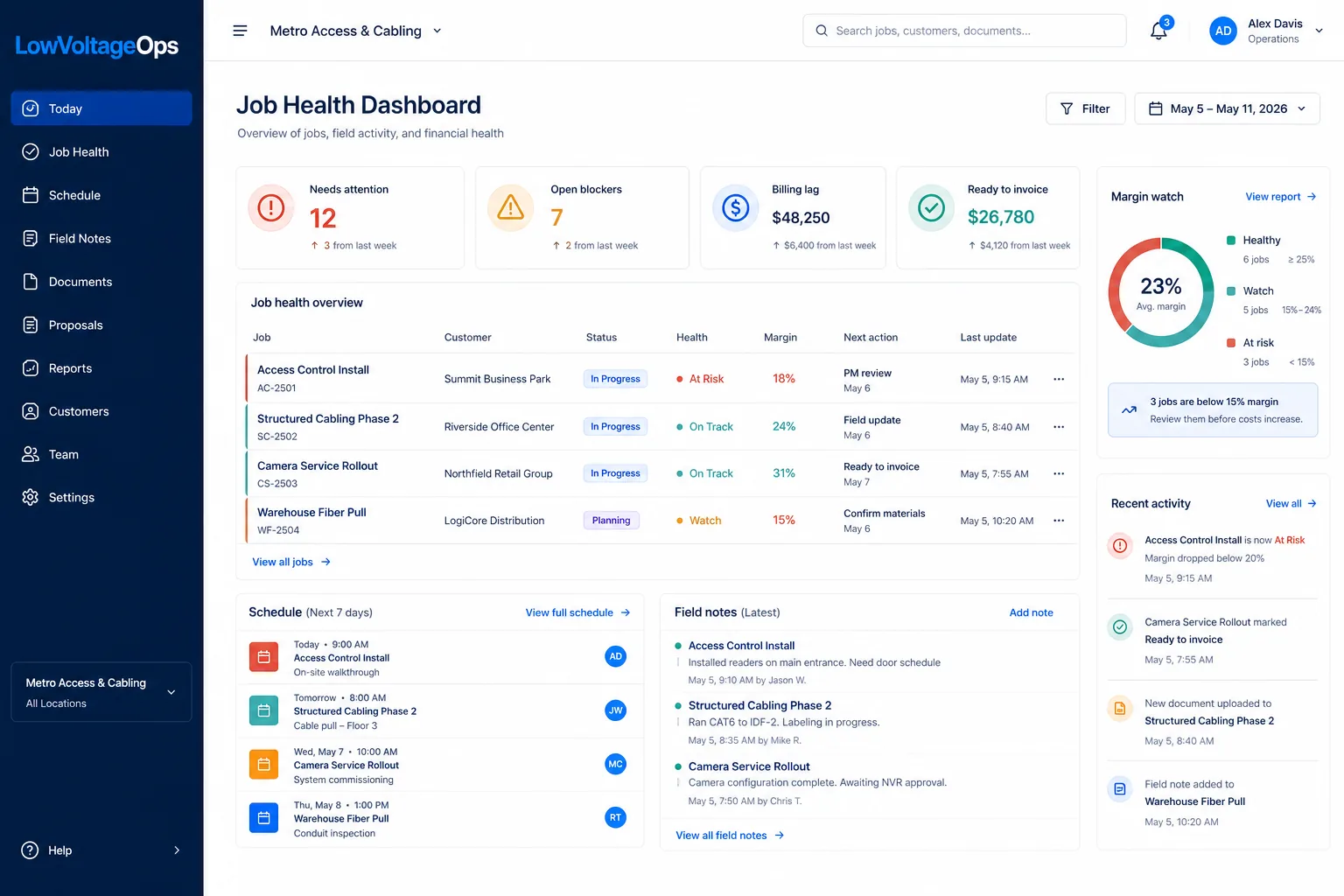
Low voltage contractors do not just need a better estimate template or a cleaner task list. They need estimating and project management connected, because the decisions made during sales become the assumptions that determine job success: labor budget, materials, exclusions, access requirements, closeout requirements, schedule pressure, change order exposure, and billing readiness.
Why estimating and project management should be connected
Most job problems start before the field team arrives. A proposal may include assumptions that never make it to the PM. A labor budget may be approved without explaining what the estimator expected the crew to complete each day. A customer may accept an alternate, exclude a pathway, or delay access without the office capturing that context clearly. When the project starts, the PM inherits a number, a scope summary, and a folder, but not the full operating plan.
That handoff gap creates predictable pain for low voltage contractors. Crews ask questions the PM cannot answer quickly. Extra work happens before a change order is written. Materials arrive late because the estimate did not translate into a procurement checkpoint. Closeout documents are treated like an end-of-job cleanup task instead of a requirement that should be planned from day one.
Good low voltage estimating and project management software closes that gap. It turns the approved estimate into an operating record: what was sold, what was assumed, who owns the next step, what must be scheduled, what proof the field needs to collect, and what accounting needs before billing.
The sales-to-operations handoff low voltage teams need
A clean handoff should make the job understandable without forcing the PM to reverse-engineer the quote. For a cabling project, that might include the number of drops, cable type, labeled areas, testing expectations, rack work, patch panel requirements, lift needs, and customer access windows. For a security project, it may include camera counts, camera views, door schedules, credentials, monitoring notes, network requirements, device programming, and training. For an AV or networking project, it may include equipment lists, install locations, commissioning requirements, rack details, owner-furnished items, and punch expectations.
The important point is that the estimate is more than a price. It is the first version of the job plan. If the estimating system and project management system are disconnected, the company loses valuable context at the exact moment the work becomes expensive to manage.
| Handoff item | Why it matters | Where it should appear after approval |
|---|---|---|
| Scope and exclusions | Prevents unclear ownership and protects change orders. | Job overview, PM notes, field instructions, customer-facing scope. |
| Labor assumptions | Gives PMs a baseline for schedule and margin watch. | Job budget, schedule plan, profitability dashboard. |
| Material assumptions | Helps identify procurement risk before field work starts. | Material checklist, blockers, job readiness review. |
| Site access requirements | Prevents wasted trips and hidden labor cost. | Schedule notes, field instructions, blocker tracking. |
| Closeout requirements | Protects billing readiness and customer acceptance. | Closeout checklist, field proof requirements, accounting view. |
| Alternates and allowances | Creates visibility into pricing decisions that may change. | Change order watch, PM review, customer decision list. |
What the software should track after the job is won
Job setup and ownership
Once a proposal is approved, the system should create or update a job record with customer, site, scope, PM owner, important contacts, schedule expectations, job type, files, and next actions. The first operational question should be simple: who owns the job and what has to happen next?
Schedule readiness
A calendar date is not the same as a ready job. Low voltage contractors should track whether materials are ordered, access is confirmed, customer decisions are complete, drawings are available, permits or badges are handled, and prerequisite work by other trades is ready. Schedule readiness helps prevent the crew from showing up before the job can actually move.
Field notes and proof of work
Field notes should not be trapped in text messages. They should attach to the job with date, technician, work completed, blockers, photos, and follow-up needs. This is especially important when the field team identifies added scope, access issues, damaged existing conditions, or work completed that will later support billing.
Change order exposure
Extra devices, pathway changes, after-hours access, owner-directed revisions, failed existing cable, and return trips can all affect margin. Software should make unapproved change work visible before it becomes a write-off. PMs and owners should be able to see pending change items, submitted change orders, approved changes, and extra work already performed.
Closeout and billing readiness
Low voltage work is often complete in the field before it is ready to bill. The system should track test results, photos, as-builts, device schedules, punch status, customer training, manuals, warranty information, final acceptance, and PM billing approval. Accounting should not have to ask three people whether a job can be invoiced.
Profitability reporting
The estimate sets the expectation. Project management shows what happened. Reporting should connect the two. Owners need to see estimated labor versus actual labor, approved and pending change orders, material cost surprises, unbilled completed work, billing lag, margin watch, and jobs that need attention before closeout.
How to compare low voltage estimating and project management software
When comparing software, avoid choosing based only on a broad feature checklist. A generic platform may have estimating, tasks, scheduling, and reports, but still fail if those pieces do not match low voltage work. Use these questions during evaluation.
- Can approved proposal details become a job record? The PM should not have to rebuild scope, contacts, files, assumptions, and job budget by hand.
- Can the field team update the job without friction? If updates are hard to submit, the dashboard will go stale and the office will return to calls and texts.
- Can the system show job health, not just job status? Owners need risk signals: blockers, billing readiness, margin watch, schedule movement, and old next actions.
- Can closeout requirements vary by job type? Structured cabling, cameras, access control, AV, and service work do not need identical closeout packages.
- Can accounting see billing readiness? The system should show why a job is ready to invoice or what is still missing.
- Can reporting explain margin movement? Labor variance is more useful when it is connected to field notes, change orders, blockers, and schedule history.
A recommended workflow for growing low voltage contractors
The strongest operating workflow is straightforward: sell the work, convert the sale into a job, schedule based on readiness, capture field reality, review job health weekly, prepare closeout continuously, and invoice with backup ready. Each step should leave a clear record for the next person.
For example, an estimator may quote a camera installation with 18 cameras, one NVR, owner-furnished network access, after-hours work in two areas, and customer approval required for final camera views. Once approved, that information should become part of the project record. The PM should see it during job setup. The field team should know what proof to collect. The closeout checklist should include camera screenshots, device list, login handoff, training confirmation, and customer approval. Accounting should see when the job is invoice-ready.
That is the difference between software that stores information and software that runs the business. Low voltage teams need the second one.
Where LowVoltageOps fits
LowVoltageOps is positioned as low voltage contractor software because it focuses on the operating workflow around jobs, field updates, scheduling, documents, billing readiness, margin visibility, and reporting. It is not meant to be another disconnected task app. The goal is to give owners, PMs, field teams, and accounting a shared view of what was sold, what is happening, what is blocked, what is ready to bill, and where profit may be at risk.
If your company is evaluating low voltage job management software, low voltage scheduling software, or low voltage reporting software, make sure estimating assumptions can stay connected to the job after the proposal is approved. That connection is where many contractors recover lost time, reduce billing lag, and improve margin visibility.
Frequently asked questions
What is low voltage estimating and project management software?
It is software that helps low voltage contractors connect proposals, scope, labor assumptions, materials, job setup, scheduling, field updates, change orders, closeout documentation, billing readiness, and profitability reporting.
Why should estimating connect to project management?
The estimate contains the first version of the operating plan. If labor assumptions, scope boundaries, materials, exclusions, and closeout requirements do not carry into project management, PMs and field teams lose context that affects schedule, billing, and profitability.
What should low voltage contractors track after a proposal is approved?
They should track job owner, approved scope, schedule readiness, crew assignments, material status, field notes, photos, RFIs, change orders, closeout requirements, billing readiness, labor variance, and margin risk.
Is LowVoltageOps estimating software?
LowVoltageOps is best described as an operating system for low voltage contractors. It connects the job workflow around proposals, operations, field updates, scheduling, documents, billing readiness, margins, and reporting so the team can manage work after the sale without losing estimating context.