
Target query: low voltage job tracking software
Low Voltage Job Tracking Software: What Contractors Should Track
Low voltage job tracking software should give owners, PMs, field leads, schedulers, and accounting one reliable view of what is happening on every active job. For commercial low voltage contractors, job tracking is not just a task list. It is the operating record for scope, schedule readiness, field updates, blockers, change orders, closeout, billing readiness, and job health.
What is low voltage job tracking software?
Low voltage job tracking software is a system for tracking the live status of commercial low voltage jobs. It helps contractors answer practical operating questions: which jobs are active, who owns them, what is scheduled, what the field completed, what is blocked, what documents are missing, what change work is pending, what is ready to bill, and which jobs need owner or PM attention.
That makes job tracking different from a simple project board. A board can show tasks. A true low voltage job tracking workflow shows the full job condition. It connects the estimate, customer site, PM owner, schedule, field notes, photos, blockers, closeout requirements, billing status, and profitability signals into one place.
This matters because low voltage work has details that generic task tools usually miss: device lists, cable tests, labeled photos, redlines, pathway changes, programming status, site access issues, customer decisions, punch work, training, sign-off, and closeout documents. If those details are scattered across texts, emails, folders, and spreadsheets, the company does not really have job tracking. It has job chasing.
Why low voltage jobs become hard to track
Small contractors can often keep job status in the owner's head. That stops working as the company adds PMs, crews, service calls, larger projects, and more customer expectations. The problem is usually not that the work is invisible. The problem is that the work is visible in too many places.
A technician sends photos by text. A PM keeps a punch list in a spreadsheet. The estimator has scope details in the proposal. Closeout files sit in a folder. Accounting asks whether the job is ready to invoice. The owner asks which jobs are at risk. Each person has part of the truth, but nobody has the full operating view.
That scattered job truth creates real business cost. Billing slows down because closeout is unclear. Change orders get missed because field proof is buried. Crews lose time because site readiness was not tracked. PMs spend the week chasing updates instead of managing risk. Owners find margin problems after the labor has already been burned.
What low voltage contractors should track on every job
The exact fields depend on the type of work, but most commercial low voltage contractors need the same core operating record. The goal is not to create busywork. The goal is to make the job easy to understand without calling three people first.
1. Job identity and ownership
Every job should have a customer, site, PM owner, field lead, job type, status, expected dates, scope summary, and next action. If ownership is unclear, job tracking breaks before the field ever arrives.
2. Scope and handoff details
The job record should show what was sold, what was excluded, what assumptions were made, what materials are expected, and what customer decisions are still open. This is where estimating and project management need to connect.
3. Schedule readiness
A date on a calendar is not enough. Track whether materials are ready, site access is confirmed, drawings are available, prerequisites are complete, customer contacts are known, and other trades are out of the way. Crews lose margin when they are scheduled before the job is actually ready.
4. Field notes, photos, and blockers
Technicians should be able to capture work completed, photos, blockers, return needs, site conditions, and customer requests directly into the job. Field updates should be structured enough for PMs to act on them and clear enough for owners to understand job health.
5. Change order exposure
Track pending, submitted, approved, rejected, and unresolved change work. Low voltage jobs create change order exposure through added drops, device changes, pathway issues, bad existing cable, after-hours requests, customer delays, ceiling access, programming changes, and redesigns.
6. Closeout and billing readiness
Low voltage job tracking should show whether closeout is complete, what is missing, whether punch items remain, whether the customer signed off, whether PM approval is complete, and whether accounting can invoice. This is where job tracking turns into cash flow improvement.
7. Job health and margin risk
Owners need a simple view of jobs that are aging, blocked, over budget, underdocumented, not billing-ready, waiting on change orders, or missing closeout. A low voltage job health dashboard should turn job tracking data into weekly management decisions.
A practical job tracking workflow from kickoff to invoice
The best low voltage job tracking workflow follows how the job actually moves. It starts when the proposal is approved and ends when the invoice, closeout, and margin review are complete.
- Approved work becomes a job record. Customer, site, scope, files, budget assumptions, PM owner, and target dates are captured before kickoff.
- PM confirms readiness. Materials, drawings, access, prerequisites, customer contacts, and schedule constraints are reviewed before crew time is committed.
- Field updates the job as work happens. Notes, photos, blockers, punch items, and completion proof are captured in the job record instead of scattered across text threads.
- PM manages exceptions. Blockers, potential change orders, missing materials, customer issues, and schedule risk are reviewed while the job is still active.
- Closeout gets built during the job. Test results, labeled photos, redlines, device lists, training notes, and sign-off are collected before the final scramble.
- Billing readiness is visible. Accounting can see whether the job is ready to invoice, what is missing, and who owns the next step.
- Owner reviews job health weekly. Aging jobs, billing lag, margin watch, change order risk, and PM workload are reviewed before problems become surprises.
How job tracking changes by low voltage trade
All low voltage contractors need job visibility, but the details change by trade. Structured cabling teams need drops, labeling, test results, redlines, rack work, IDF/MDF notes, and as-builts. Security integrators need cameras, access control doors, panels, credentials, programming, customer testing, and commissioning proof. AV integrators need equipment status, room readiness, cabling, control programming, punch lists, customer training, and handoff notes.
That is why low voltage contractor software should be configurable around operating workflows, not locked into a generic dispatch model. A contractor doing both projects and service needs the job record to support PM work, field work, service follow-up, closeout, billing, and reporting without forcing the team to maintain separate systems.
Low voltage job tracking software scorecard
Use this scorecard when comparing software. The right tool should reduce job chasing, make PM accountability clearer, improve field visibility, and help completed work become invoice-ready faster.
| Tracking area | What the system should show | Why it matters |
|---|---|---|
| Active jobs | Status, PM owner, field lead, schedule, next action, and blocker summary. | Gives owners and PMs a clean weekly operating view. |
| Field updates | Notes, photos, completion proof, blockers, return needs, and site conditions. | Reduces update chasing and protects job documentation. |
| Schedule readiness | Materials, access, drawings, customer contacts, prerequisites, and constraints. | Prevents wasted trips and jobs starting before they are ready. |
| Change orders | Potential, pending, submitted, approved, and unresolved change work. | Keeps extra work from disappearing into labor cost. |
| Closeout | Photos, test results, redlines, as-builts, punch, sign-off, and training notes. | Turns closeout into a live workflow instead of an end-of-job scramble. |
| Billing readiness | Ready-to-bill status, missing items, PM approval, and accounting handoff. | Reduces billing lag and improves cash flow. |
| Job health | Aging jobs, blocked jobs, margin watch, labor risk, and missing closeout. | Helps leadership act before problems are buried in month-end reports. |
Where LowVoltageOps fits
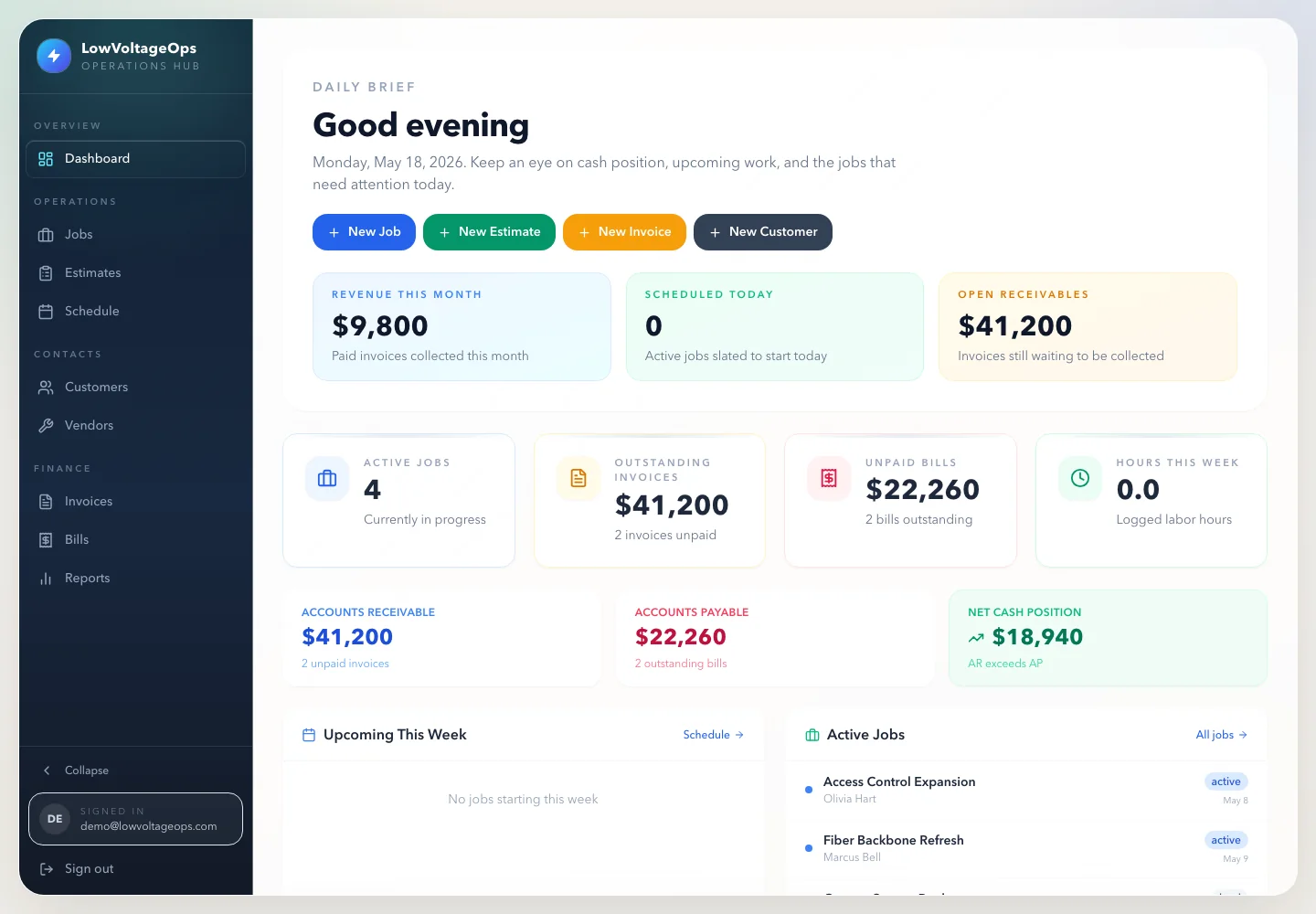
LowVoltageOps is built as an operating system for commercial low voltage contractors. It connects jobs, field updates, scheduling, proposals, documents, closeout, billing readiness, margins, and reporting in one workflow. The focus is not just creating more tasks. The focus is giving the company one reliable job record that PMs, field teams, accounting, and owners can use.
If you are comparing low voltage job management software, low voltage project management software, low voltage scheduling software, or low voltage billing readiness software, the key question is whether the system can show the real condition of each job without forcing your team to chase updates manually.
Frequently asked questions
What is low voltage job tracking software?
Low voltage job tracking software helps contractors track active jobs, PM ownership, field updates, blockers, schedule readiness, closeout requirements, change orders, billing readiness, and job health for cabling, security, access control, AV, and related low voltage work.
What should low voltage contractors track on every job?
Low voltage contractors should track scope, PM owner, schedule status, site readiness, material status, field notes, photos, blockers, change orders, punch items, closeout requirements, billing readiness, labor burn, and margin risk.
How is job tracking different from project management software?
Job tracking is the operating view of what is happening on each job right now. Project management software may include tasks and schedules, but low voltage job tracking needs field proof, blockers, closeout status, billing readiness, and margin visibility tied to the job record.
Can job tracking software reduce billing lag?
Yes. When field proof, closeout status, change orders, punch items, and PM approval are tracked in one job record, accounting can see what is ready to bill and what is still missing before invoices stall.